
How to frame a jigsaw puzzle
To frame a jigsaw puzzle, keep it assembled on a flat board, measure the finished puzzle, then decide three things: how it is held (glued, backed, or held flat without glue), whether it gets a mat, and the glazing over it, in a frame cut to its size. We custom frame jigsaw puzzles at our Costa Mesa shop.
A puzzle finished over the holidays is often the one a family wants to keep: the one built on the dining table across a week of visits, or a picture good enough to hang on its own. None of it has to be valuable; it only has to mean something to someone.
How do you frame a puzzle already assembled?
Move it flat, then measure the puzzle itself. Slide the finished puzzle onto a piece of stiff board so it never bends on the way, and put any loose pieces in a bag that travels with it. Measure the assembled puzzle rather than reading the box: the size printed on the box is not always exactly the size of the finished puzzle, and the frame is built to the real one.
Every frame we make is cut to the piece it holds and crafted by hand in our Costa Mesa warehouse, so a puzzle never has to fit a stock size. Our frame and mat size guide explains how frames are named and how wide a mat should be.
Can you put a puzzle in a frame without gluing it?
Yes. Holding it flat without glue is one of three common ways to keep a puzzle together in a frame, and each one trades how secure the pieces are against whether the puzzle can ever come apart again.
- Glue on the front. Puzzle glue is brushed over the face and into the seams. It holds the pieces for good, it can leave a sheen on the picture, and it cannot be undone.
- A backing on the reverse. The puzzle is fixed from behind, to adhesive sheets or a mounting board. The picture side is left alone, but the backing generally stays on.
- No glue at all. The puzzle lies on a firm backing and the glazing holds it flat, in a frame cut close to its edges so the pieces have little room to move. Opened again, it is a puzzle again, though it suits some puzzles better than others.
Which one suits a puzzle depends on its size, what it is made of and whether you might want to build it again. Bring it in and ask at the counter whether yours can be framed without glue. Whatever holds it, our store is completely acid-free, mats included, so nothing behind the puzzle burns a brown line into it over the years.
Mat or no mat?
Either can be right; it comes down to the picture and the wall. Without a mat, the frame sits close against the edge pieces. With one, a common starting point is a border of about 2 to 3 inches on small and medium pieces and 3 to 4 inches or more on large ones, often a little wider at the bottom than the top. Ask whether the mat should overlap the edge pieces slightly or leave the whole edge in view. If the puzzle is held without glue, ask whether it can take a mat at all, because there the glazing is what holds the pieces flat.
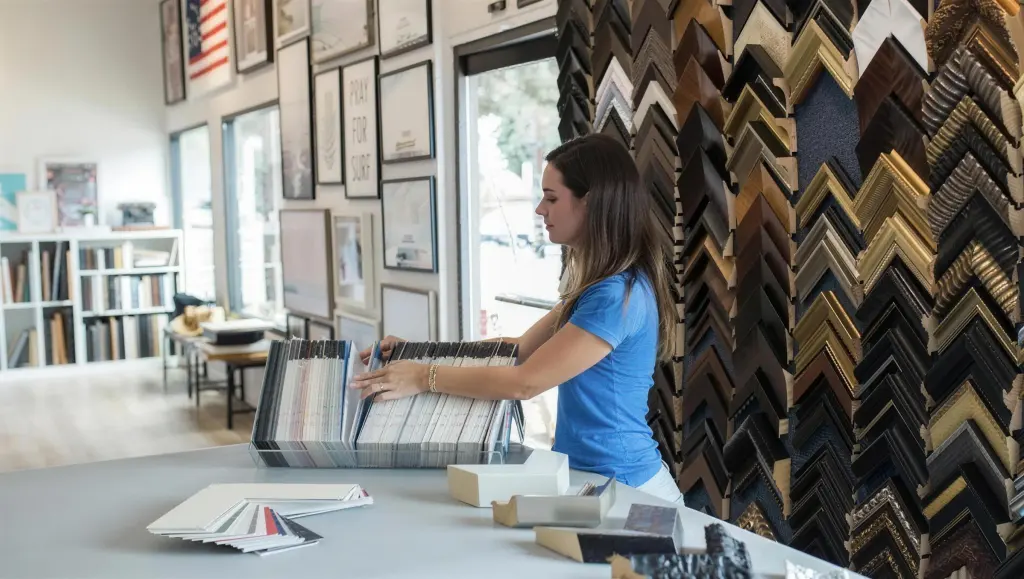
A mat can carry more than the puzzle, too. Multiple openings, lettering and shapes can all be programmed into our computerized mat cutter, so a mat can hold a line of lettering beneath the picture: a date, or the names of the people who built it. The moulding and the mat are chosen at our custom framing counter with the real samples held against the piece, rather than picked from a screen.
Does a framed puzzle need glass?
Usually, yes. Glazing protects the picture, and in a frame without glue it is also what holds the pieces flat. Most jigsaw puzzles are a printed picture on cardboard, and daylight fades pigment, slowly and unevenly. Regular clear glass keeps dust and fingers off; slowing the fading is the job of museum-quality and UV-protective glazing, chosen with you for the piece. Our guide to museum glass vs regular glass explains the difference.
How can I hang my puzzle on the wall?
In a frame, on hardware matched to its weight and to the wall behind it. A light piece can go on a picture hook rated for the weight, on drywall; a medium or heavy one wants D-rings on the back of the frame and screws into a stud or anchors rated for the load. Hang it so its center sits about 57 to 60 inches from the floor. How to hang art covers the rest, and our crew delivers and installs art in and around Orange County, with delivery quoted separately.
When should a Christmas puzzle come in?
By December 15: that is our last drop-off date for orders to be completed before Christmas. Everything is specially ordered and cut to size, so tell us the date when we design it with you, and if the date is tight, call first.
Bring the puzzle to 1671 Placentia Avenue, Costa Mesa, Monday to Friday 10am to 5pm or Saturday 9am to 1pm; no appointment is needed. It is quoted in person once we have seen it, and there is no price list: the size, the moulding, the mats, the glazing and the mount are what change the quote. Comparing quotes from a big-box store, an online framer and a local shop? Ask each one how the puzzle will be held and what glazing goes over it, so you compare the same build.
Call us at (949) 791-8780, or send the quote form with the puzzle’s measurements and a photo.